READING MUSIC / LESSON 01
The Staff and the Placement of Notes
This first lesson in reading music introduces the five-line staff.

The image above shows a standard musical staff: five horizontal lines. They are numbered from bottom to top, though you do not need to memorize the line numbers. Notes are normally written on or between these five lines, but there are exceptions.

When a note lies outside the staff, we add short extra lines called ledger lines, as shown above. You will often see them in published scores. To keep notation easy to read, it is helpful to limit the number of ledger lines whenever possible. This is one reason we use different clefs, especially treble and bass clefs.
What does the Japanese name for the treble clef mean? Let us begin with the note names.
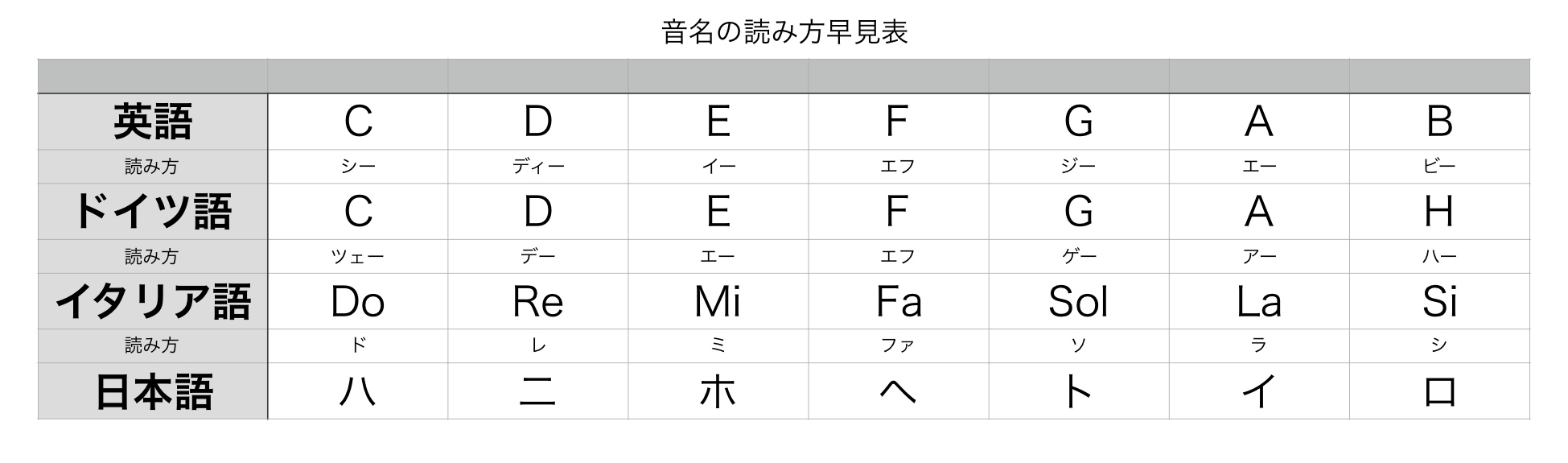
In Japanese solfège, the syllable “to” corresponds to “sol” (or “so”), the fifth note of do–re–mi–fa–sol–la–si–do. These syllables originate in Italian solfège.
Now back to the treble clef. Its curled center wraps around the line that represents G (sol). The clef therefore tells us where that reference pitch belongs on the staff.
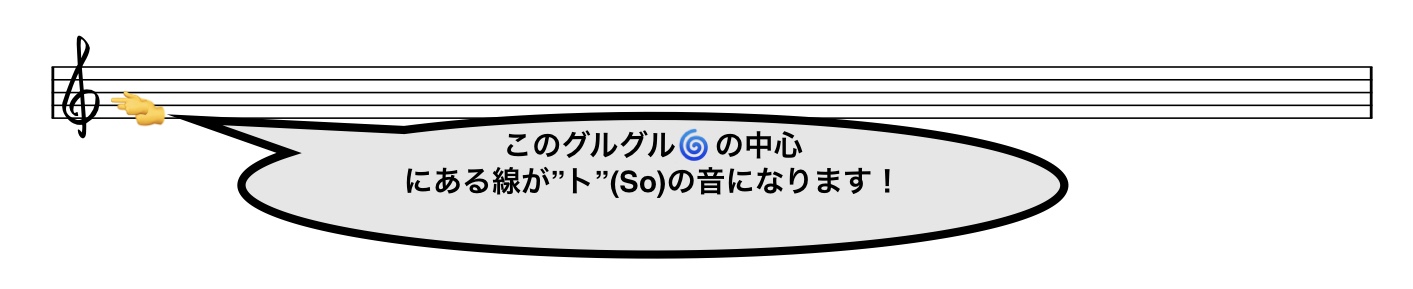
The second line from the bottom is G—the G above middle C on a piano. Once that reference point is clear, you can identify the other notes.

That is how the pitches fit together. Reading notation is rather like learning a language: once you understand its rules, it becomes much easier.
The bass clef instead identifies the position of F (fa), indicated by its two dots around the relevant line.

This F is below middle C on the piano. The bass clef is therefore particularly suitable for writing lower notes.
1. A staff has five lines; ledger lines extend it when needed.
2. A treble or bass clef establishes a reference pitch on the staff.
3. The treble clef is usually used for higher notes, and the bass clef for lower notes.
In this lesson we learned how to read the staff. With these reference points in mind, you can begin to identify the pitches represented by written notes.
Pivo Music School