JAZZ PIANO / LESSON 04
Bebop Scale in a Bud Powell Phrase
In our series analyzing phrases by legendary jazz pianists, we turn from Red Garland to Bud Powell. This time we study two bars from the bridge of the second chorus of 'Anthropology,' recorded live at Copenhagen’s Café Montmartre in early 1962.
Have a look at the transcription below, then listen to the performance example. This is a wonderful example of bebop vocabulary, with hints of the fifth mode of harmonic minor (often called Phrygian dominant).

The phrase begins on the offbeat of beat one with the third of D7. On beat two we hear the fifth, followed by the flat ninth on the upbeat.
Now for the key idea: the bebop dominant scale. On the upbeats of beats three and four, Powell inserts C♯, the major seventh of D, between notes of the D Mixolydian scale. Compared with a conventional Mixolydian or Phrygian dominant line, this chromatic passing tone is distinctive.
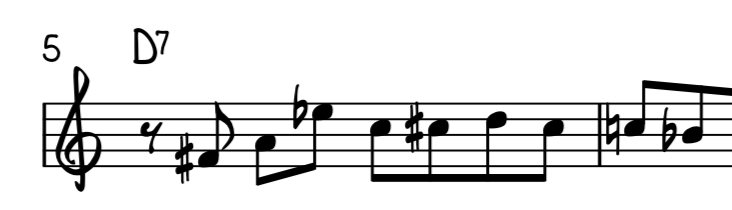
The extra C♯ places the chordal seventh, C natural, on a strong beat. That rhythmic alignment allows the harmony to come through even when the solo line is played without accompaniment. It is an essential technique in flowing eighth-note bebop passages.
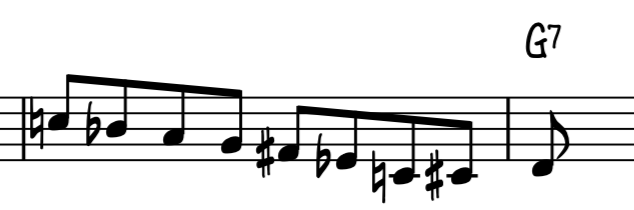
At the beginning of bar two, the line lands on C natural, the flat seventh of D7. Powell then uses notes associated with the fifth mode of G harmonic minor through beat three.
C♯ appears again on the upbeat of beat four and leads toward D, the fifth of the following G7 chord. Here it can also be heard simply as a chromatic approach note.
The D7 at the beginning of a rhythm-changes bridge appears in many jazz situations. Try practicing this idea and using it in your own lines. I hope it helps both self-taught players and musicians who already attend jam sessions.