CHORD THEORY / LESSON 10
The Half-Diminished Seventh Chord
This lesson introduces the minor seventh flat five chord, also known as the half-diminished seventh chord. Its name looks long, but the construction is straightforward once you know the minor seventh chord.
Start by looking at the first notation example.
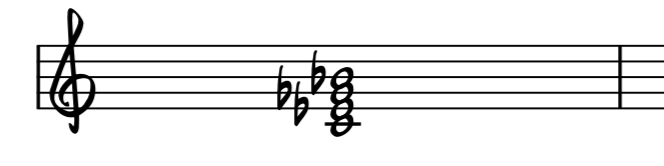
The chord shown is built on C and is called C minor seven flat five: Cm7♭5. Its notes are C–E♭–G♭–B♭.
The name tells us how to construct it: begin with a C minor seventh chord (C–E♭–G–B♭), then lower its fifth, G, by one semitone to G♭.
Count upward from C: C (1), D (2), E (3), F (4), G (5). The fifth is G, so “flat five” means lowering G to G♭.

Compare the keyboard illustrations: the original Cm7 chord contains G, while Cm7♭5 contains G♭. The other three notes remain unchanged.
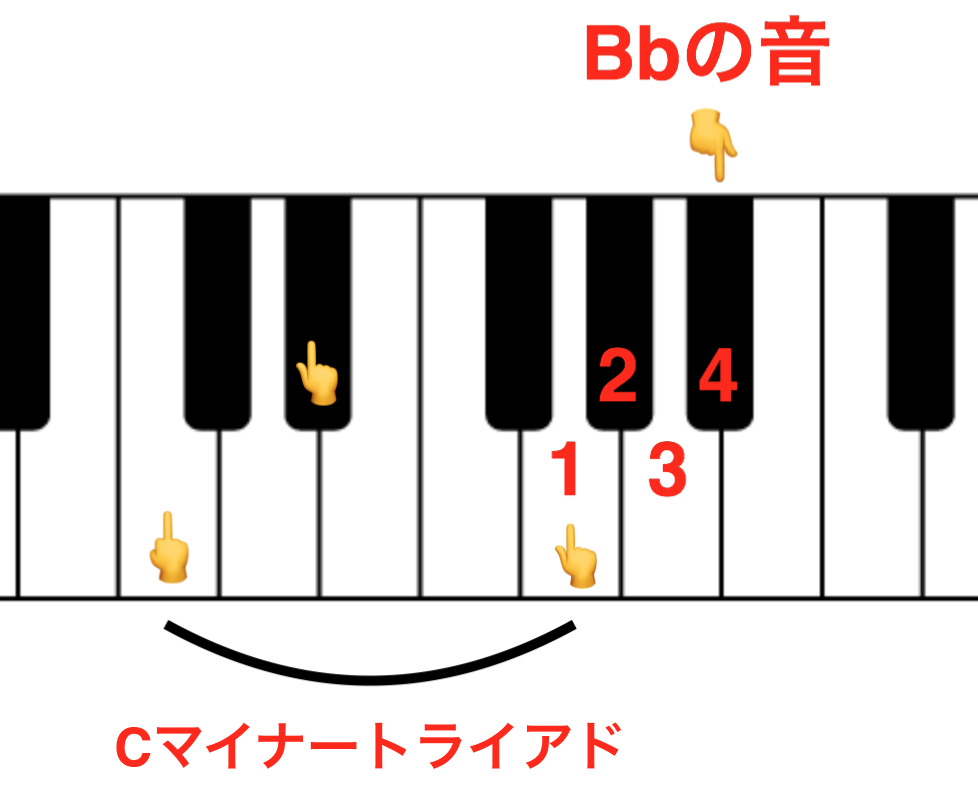
If you need to review how to build a minor seventh chord, see the related lesson below.
The result is a four-note chord with the intervals root, minor third, diminished fifth, and minor seventh. It can be written Cm7♭5 or Cø7.
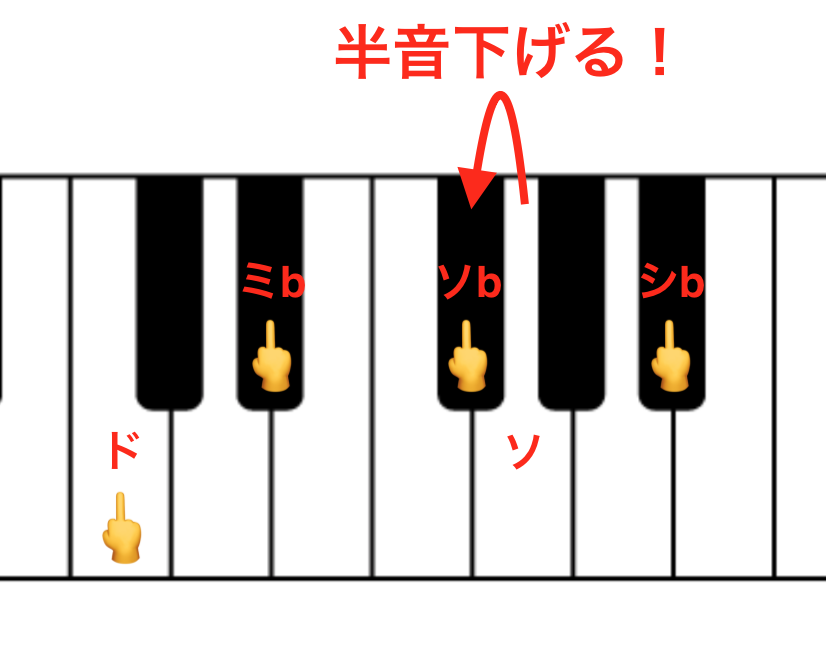
Two commonly used names refer to this same chord: “C minor seven flat five” and “C half-diminished seventh.” Both are useful to recognize in jazz charts and conversation.
Summary: build a minor seventh chord and lower its fifth by a semitone. For C, that produces C–E♭–G♭–B♭. The symbol ø means half-diminished.