JAZZ PIANO / REHARMONIZATION
Reharmonizing Misty for Jazz Piano: Kenny Barron Voicing, Tritone Substitution & Diminished Chords
Just two bars from the opening of the jazz standard “Misty”: let's turn a straightforward B♭7 → E♭maj7 progression into a richer harmonic statement without losing the melody.
We will explore three practical ideas: Kenny Barron Voicing, tritone substitution, and the diminished major seventh chord. Start by listening to the Instagram performance, then follow the notation and the voice leading.
Listen to the reharmonization first
If the embedded video does not load, watch the performance on Instagram.
1. The original V7 → Imaj7 progression
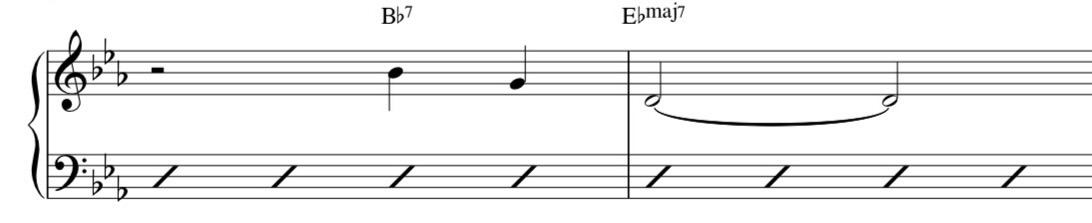
“Misty” is in E♭ major. At the opening, the dominant seventh chord B♭7 (V7) resolves to the tonic E♭maj7 (Imaj7). This familiar sound gives us a clear starting point for reharmonization.
We will now expand the dominant, substitute a chord, and create a more expressive resolution through voice leading.
2. Fm7 and the Kenny Barron Voicing
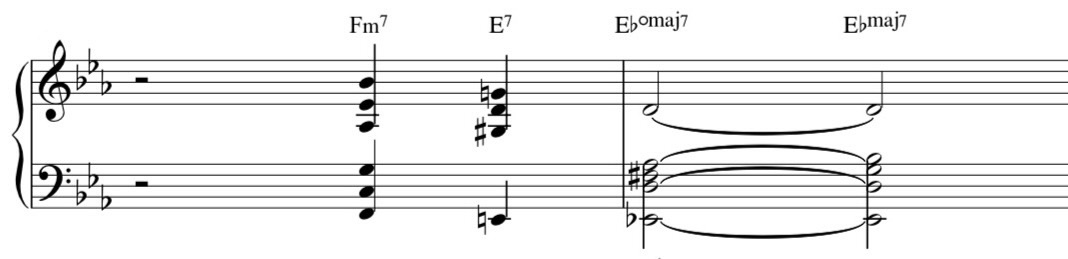
First, expand B♭7 into a ii–V: Fm7 → B♭7. Place Fm7 under the melody note B♭; this melody note functions as the 11th of Fm7.
For Fm7, use the six-note arrangement commonly known as the Kenny Barron Voicing:
The key color comes from the semitone between G (9th) and A♭ (minor 3rd) in the inner voices. This close interval creates a distinctive, gently tense texture. With the 11th on top, the voicing is particularly useful when the melody sits on that extension.
3. Replace B♭7 with its tritone substitute, E7
Next, substitute E7 for B♭7. The two dominant seventh chords share their essential guide tones enharmonically: B♭7 contains D (3rd) and A♭ (♭7), while E7 contains G♯ (3rd) and D (♭7). This is the principle behind tritone substitution.
The ♯9 adds tension, and the bass creates a smooth chromatic line: F → E → E♭. Listen to the bass movement as carefully as the upper chord.
4. Resolve through E♭°maj7 to E♭maj7
Rather than settling immediately on E♭maj7, keep E♭ in the bass and place a D major triad (D–F♯–A) above it.
This produces the color of an E♭ diminished major seventh chord (E♭°maj7). After two beats, raise two notes by a semitone: F♯ → G and A → B♭. E♭ and D remain as common tones as the chord resolves to E♭maj7.
The bass stays in place while the inner voices move by half steps. This is an example of why voice leading can be more expressive than simply adding extra chord symbols.
5. The complete reharmonized example
After
6. Practice this sound at the piano
- Play B♭7 → E♭maj7 first and listen to the standard dominant-to-tonic resolution.
- Keep B♭ as the top note of Fm7 and slowly build the Kenny Barron Voicing underneath it.
- Add E7 and focus on the descending bass line F → E → E♭.
- Practice only the two semitone movements F♯ → G and A → B♭ as E♭°maj7 resolves to E♭maj7.
- Finally, play the full passage with the melody and compare it with the original harmony.
Practice tip: The goal is not complexity for its own sake. Use your ears to judge whether the melody, inner voices, and bass connect musically.
Conclusion
In just two bars of “Misty,” we have colored an 11th in the melody with a Kenny Barron Voicing, created chromatic bass motion with a tritone substitute, and resolved smoothly from a diminished major seventh chord to the tonic. Try applying these ideas to ii–V–I passages in other jazz standards.
Pivo Music School | Online Jazz Piano Lessons
Study jazz harmony, voicings, improvisation, and reharmonization in one-to-one lessons with jazz pianist and vocalist Seiya Matsushita. A free 30-minute trial lesson is available.
Lesson and commentary: Pivo Music School / Seiya Matsushita