CHORD THEORY / LESSON 11
The Diminished Seventh Chord
Today we will build a fully diminished seventh chord. It starts with a diminished triad and adds one more note, creating a four-note chord.
If you are not yet comfortable with diminished triads, review the related lesson first.
Look at the notation example: it shows a C diminished seventh chord, usually written Cdim7 or C°7.
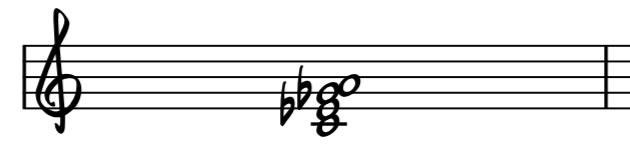
It is based on the diminished triad C–E♭–G♭. A fully diminished seventh is added above the root. This note is spelled B𝄫 (B double-flat), which sounds the same as A on an equally tempered piano.
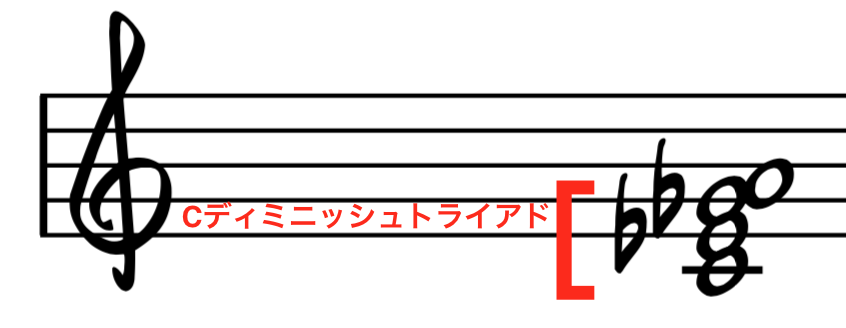
The diminished seventh may be surprising: in other seventh chords built on C, you may have encountered B or B♭. Here the seventh is lowered another semitone from B♭ to B𝄫.
You can also build the chord by stacking minor thirds: C to E♭, E♭ to G♭, and G♭ to B𝄫 (the same piano key as A). Each step spans three semitones.
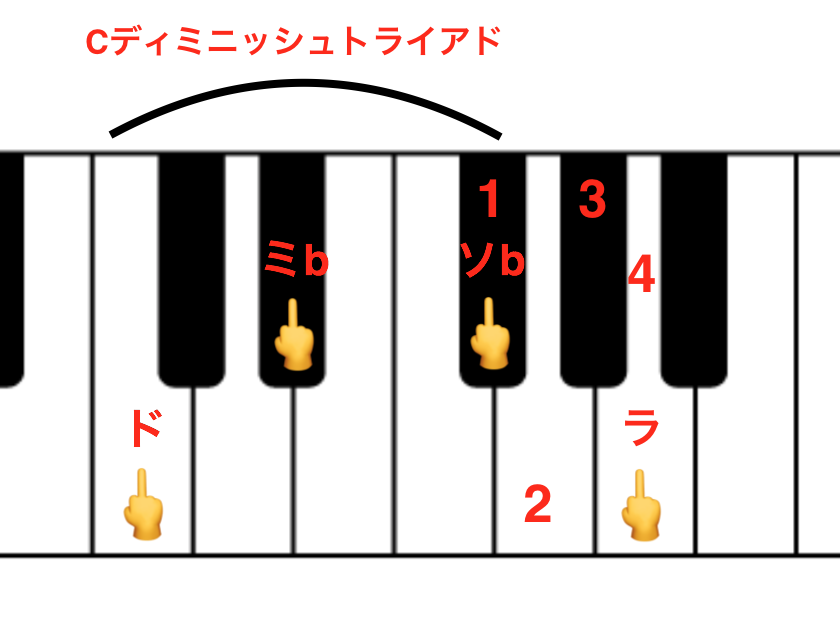
Compare the score and keyboard diagrams, and play the four notes together. The chord has a symmetrical structure that is useful in jazz harmony.
Be careful not to confuse Cdim7 with Cm7♭5 (Cø7). Cm7♭5 has B♭ as its seventh, whereas Cdim7 has B𝄫, the same sounding pitch as A.
In conversation, musicians often omit the word “chord” and simply say “C diminished seventh.” Its usual symbols are Cdim7 and C°7.
Summary: a fully diminished seventh chord consists of a root, minor third, diminished fifth, and diminished seventh. Build it as four notes separated by minor thirds.