READING MUSIC / LESSON 16
Octave Signs: How to Read 8va and 8vb
In Reading Music, Vol. 16, we explore octave signs. Have you heard this term before? Start by looking at the first musical example.

You can see the marking 8va (ottava). This is an octave sign. When is it useful?

In the example above, many ledger lines appear from the second beat in the latter part of the phrase. Even experienced readers can find so many ledger lines difficult to follow.
This is where an octave sign helps.
An octave sign makes high or low passages easier to read.
1. Write the notes one octave below the pitches you want to sound.
2. Put “8va” above the staff to show that they should sound an octave higher.
Here is the same passage notated using this rule:

And here are the pitches that actually sound:

The notes sound at the intended higher register, but the notation is much easier to read.
Octave signs can also be used for very low notes.
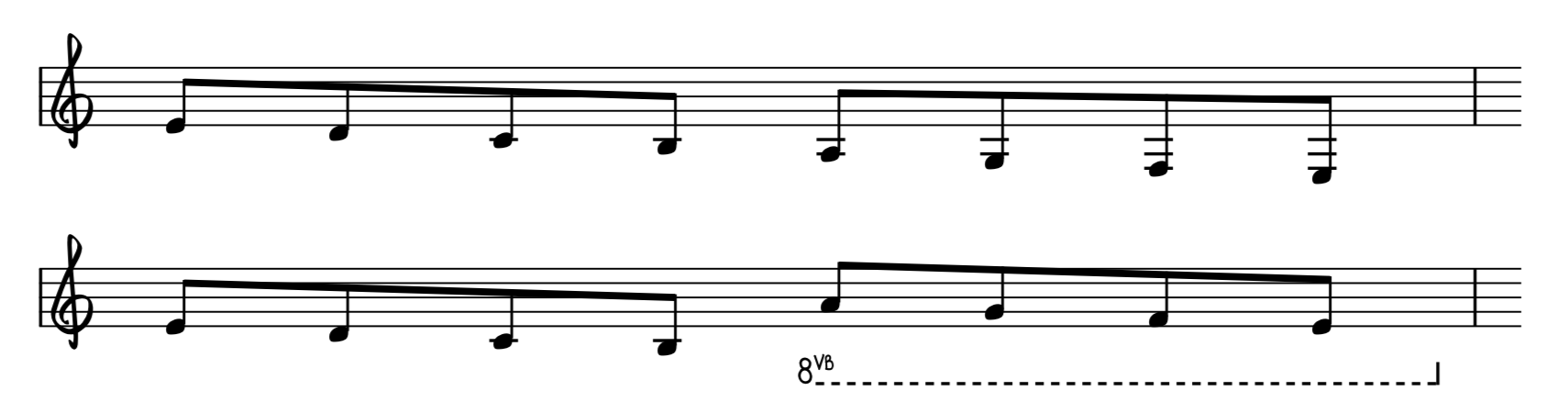
The first staff shows the actual pitches. The second shows the same pitches written with an octave sign. Both examples are played at the same sounding pitch.
The principle is the same as with an octave sign for high notes: follow the indicated octave displacement rather than playing the written pitches literally.