JAZZ PIANO / LESSON 03
Red Garland: An Outside Phrase
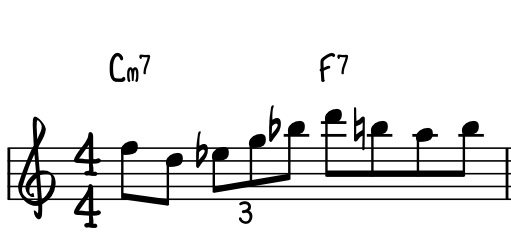
In the first installment of our series analyzing phrases by great jazz pianists, we examine a passage from Red Garland’s “I Could Write a Book.” Begin by studying the transcription below.
Here is my performance demonstration.

The phrase occurs in E♭ major over vi–II7–ii7–V7. Let us begin with Cm7–F7 in the first bar.
Over Cm7, Garland begins with F (the 11th) on beat one and D (the 9th) on its upbeat. These tensions make the opening more colorful than a straightforward arpeggio. Beat two outlines E♭, G and B♭—the 3rd, 5th and 7th. Combining tensions and chord tones gives the line a satisfying balance. Over F7 on beats three and four, the notes are D–B–C–D. B natural is the ♯11 of F7, pointing to the F Lydian dominant scale (the fourth mode of C melodic minor). I particularly like this naturally integrated ♯11 sound.
Now consider the ii–V phrase across bars two and three. Over Fm7 the eighth notes E♭–C–A♭–F–G–F give ♭7–5–♭3–1–9–1, a primarily chord-tone line consistent with F Dorian.
On the final B♭7, Garland moves outside the key: rather than the conventional B♭ Mixolydian, he uses material from E major.
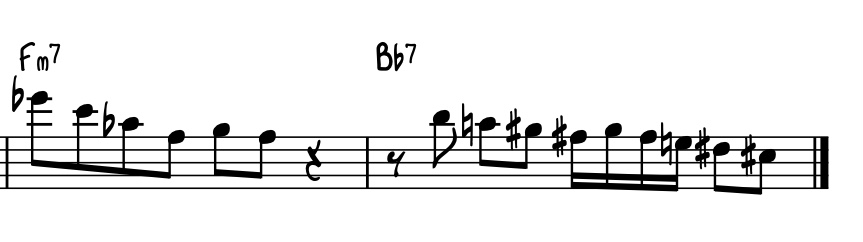
E major implies a major-seventh sonority a semitone above the destination E♭maj7. Against a B♭7 left-hand accompaniment, it creates intentional dissonance and a wonderful sense of tension before the resolution. I have encountered similar outside-playing approaches while transcribing Kenny Barron. Whether or not he was influenced by Garland, this remains a valuable device for jazz improvisers.
I hope this analysis helps pianists learning independently and those already playing at jam sessions.