JAZZ PIANO / LESSON 02
Jazz Piano Intro Patterns, Part 2
We continue our series of ten jazz intros. In Part 1 we covered patterns 1 and 2; this lesson presents patterns 3 and 4. If you have not read the previous lesson, start there.
The performance and sheet music are also available on YouTube. In this five-part article series, we explore details beyond the video.
Let us begin with pattern 3.
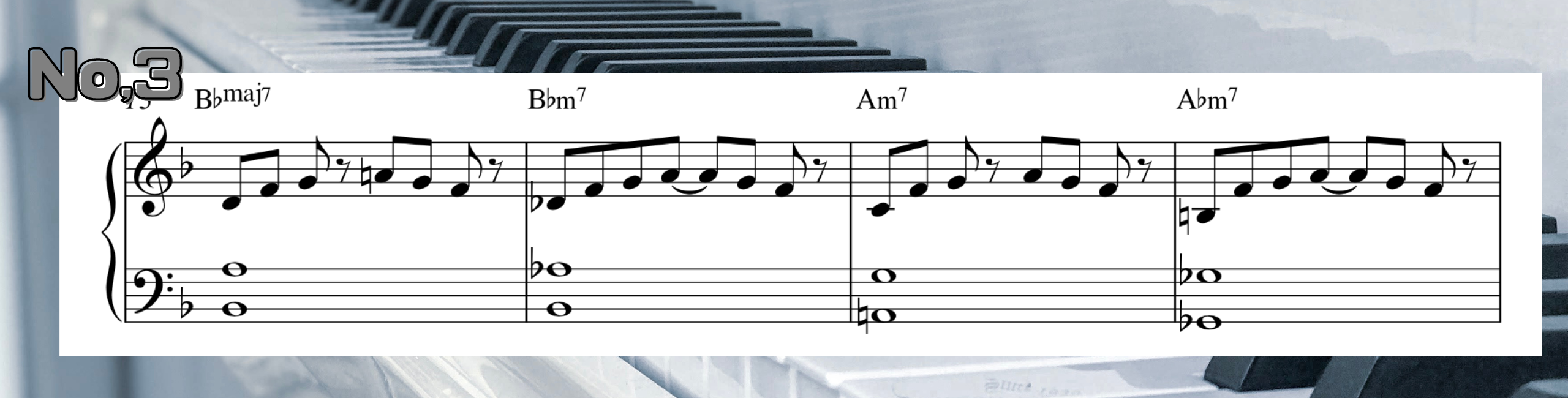
Pattern 3 starts on IVmaj7 and descends through IVm7 and IIIm7. IVm7 is a borrowed chord, an example of modal interchange from the parallel minor key. The motion IIIm7–♭IIIm7 is a chromatic approach to IIm7. After IIm7–V7, we could resolve to Imaj7; instead, the final melody ascends by semitones from the third—a familiar jazz gesture. The progression is IVmaj7–IVm7–IIIm7–♭IIIm7–IIm7–V7.
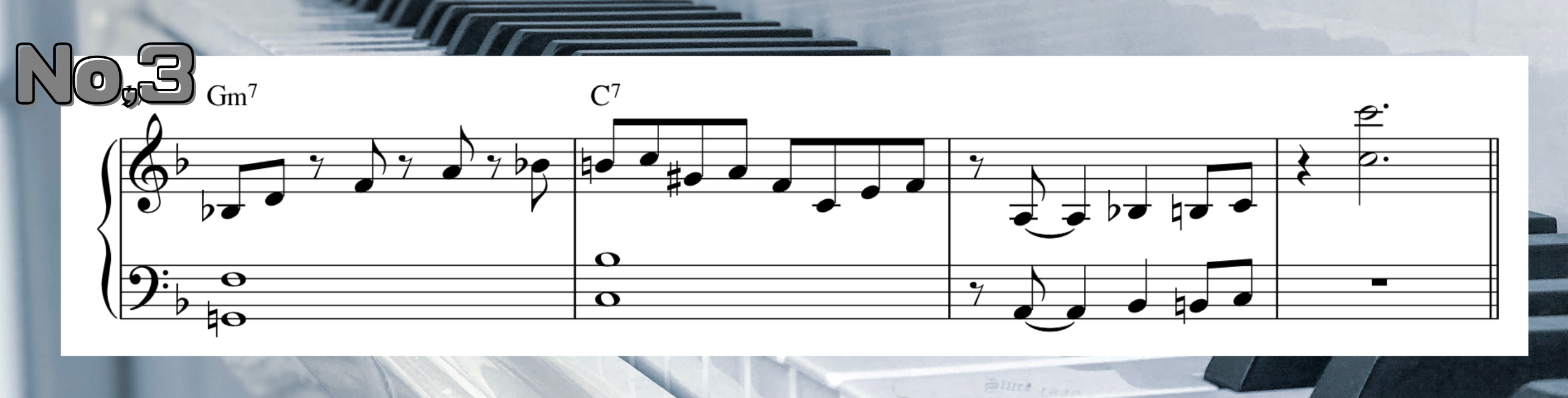
As discussed in Part 1, an intro is often played on solo piano, so voicings that include the root are especially useful.
Here I use the root and seventh in the left hand, the voicing often associated with Bud Powell. Now turn to pattern 4.
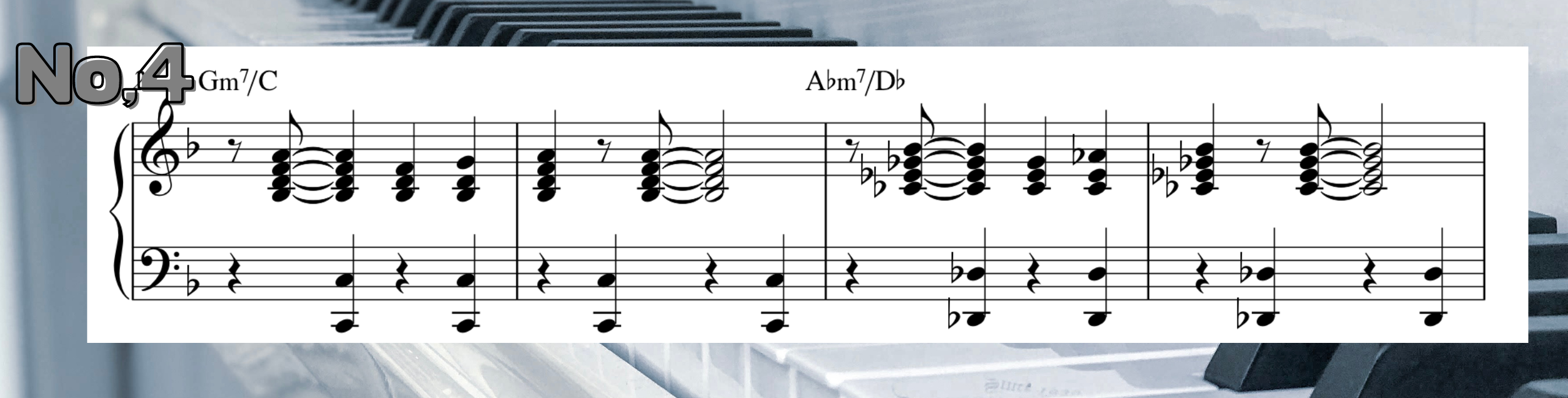
Pattern 4 uses a pedal point: the bass repeats or sustains the same note while the upper harmony moves. Dominant pedal tones are particularly common. In F major the pedal note is C. The right hand plays Gm7, making Gm7/C, which can also be heard as a C dominant suspended sonority (with 9 and 13). Playing a ii-minor-seventh voicing over the dominant bass is a useful way to obtain a sus sound. Bars three and four transpose the opening figure up a semitone; bar five returns to the original level, a familiar chromatic side-slip. On the upbeat of beat two in bar six, the right hand changes from Gm7 to C7(♭9,13), resolving to F6/C while the bass stays on C. Bar eight’s C7(♭13) finally prepares Imaj7. The underlying motion can be summarized as Gm7/C–A♭m7/D♭–Gm7/C–C7.
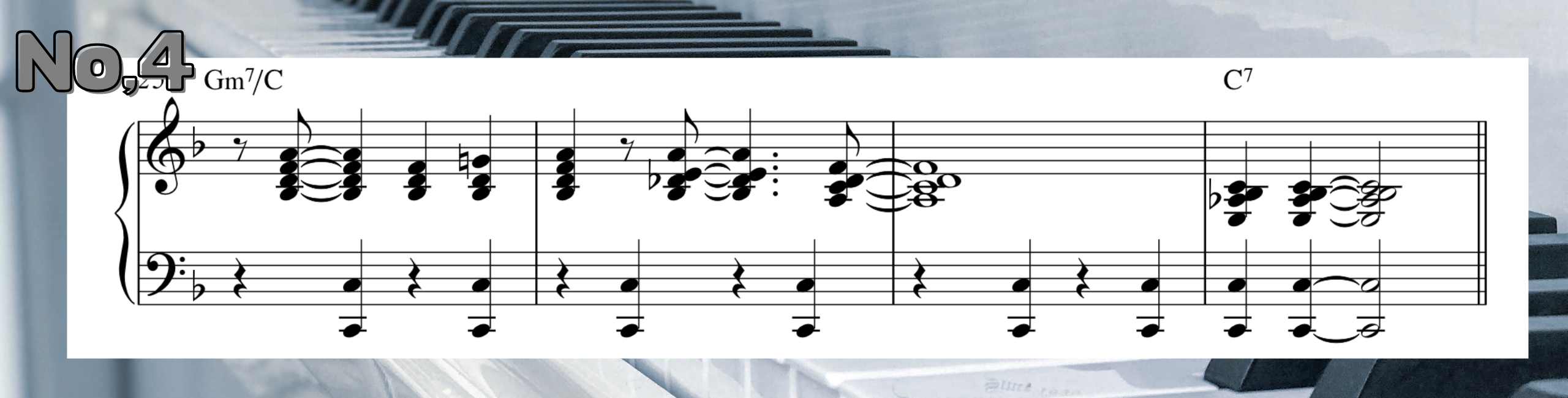
These are patterns 3 and 4. Try them in different keys, paying special attention to the harmonic release into the tune.