Jazz Piano Voicings Through Autumn Leaves
From basic 3rds and 7ths to rootless left-hand voicings and two-hand harmony. Learn with six original notation examples, two performance videos, and a piano-free backing track.
Start by listening to two performances
We use the same standard to progress from left-hand accompaniment to fuller two-hand harmony. The videos demonstrate the music; the explanations and notation below guide your practice.
Performance 1 | Left-hand voicings
Performance 2 | Two-hand voicings
STEP 1 | Build the harmony with 3rds and 7ths
Start with just the 3rd and 7th of each chord. The 3rd helps establish major or minor quality; the 7th helps define the chord and connect it to the next harmony.
Cm7 → F7 → B♭maj7 → E♭maj7: from Cm7 to F7, keep E♭ as a common tone while B♭ moves down a semitone to A.
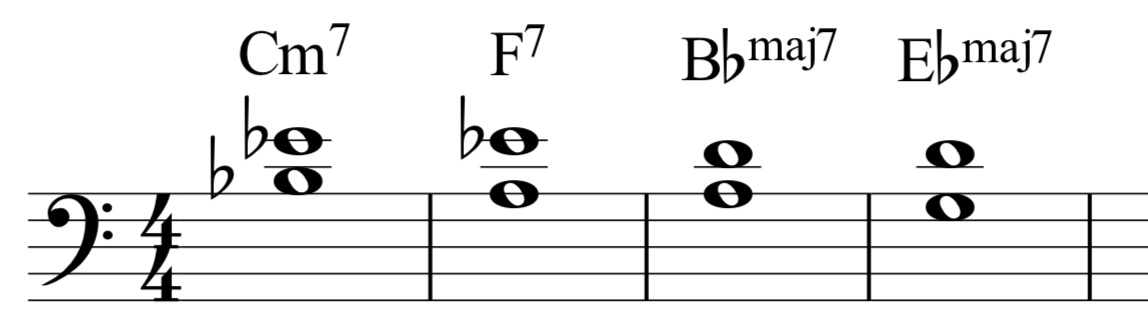
Practice: Play each chord slowly, listening for common tones and half-step voice leading.
STEP 2 | Add tensions to left-hand voicings
Now use the same progression and add colors such as the 9th or 13th. Once you know the 3rd and 7th, listen to how the added tones change the sound.
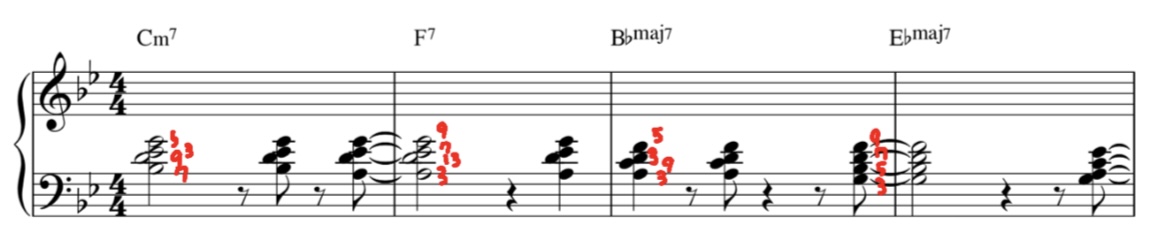
Rootless voicings are especially useful when a bassist supplies the root. Focus on smooth movement between voices rather than simply playing more notes.
STEP 3 | Expand into two-hand voicings
With both hands you can spread the harmony over a wider register, but tightly packed notes may sound muddy. Pay attention to the distribution between hands, the top note, and inner-voice movement.
The following four original examples demonstrate different voicing concepts. Each is followed immediately by an explanation and a listening or practice focus.
Example 3 | Drop 2 Voicing
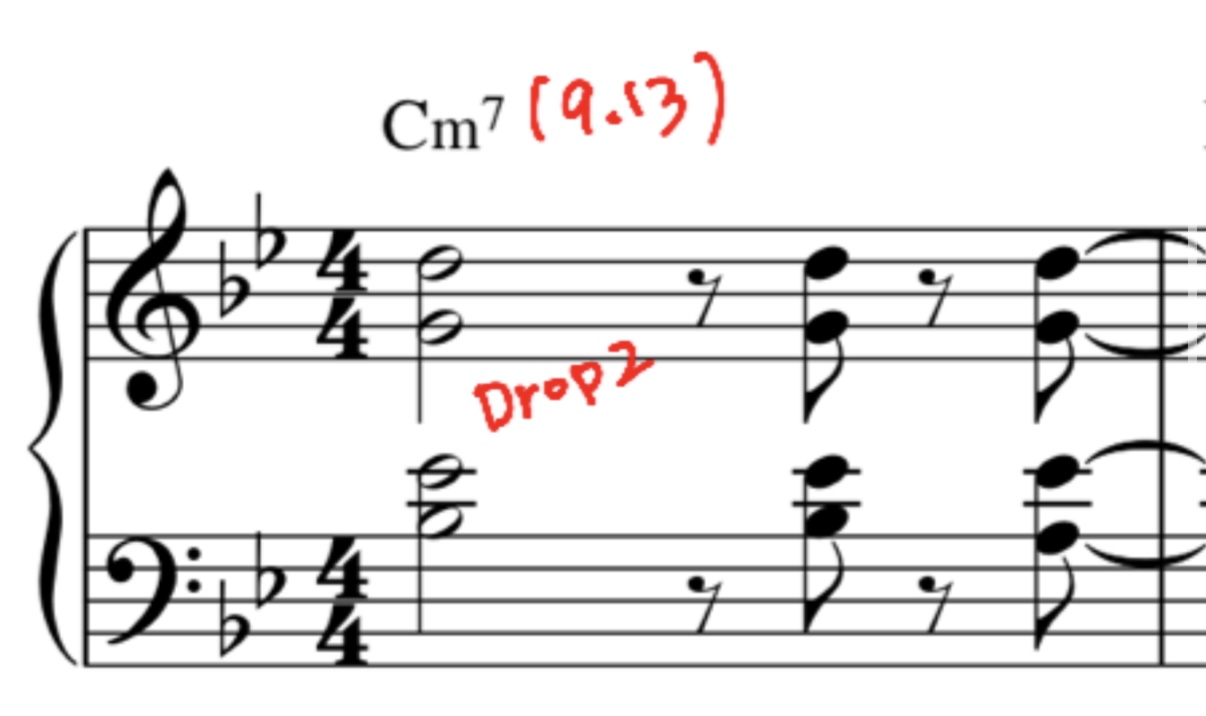
What is it? Take a close-position chord and lower its second-highest voice by an octave. This opens the spacing while allowing the top note to remain in place.
Practice focus: Listen to the lowered voice and how the upper voices connect between chords.
Example 4 | Fourth (Quartal) Voicing
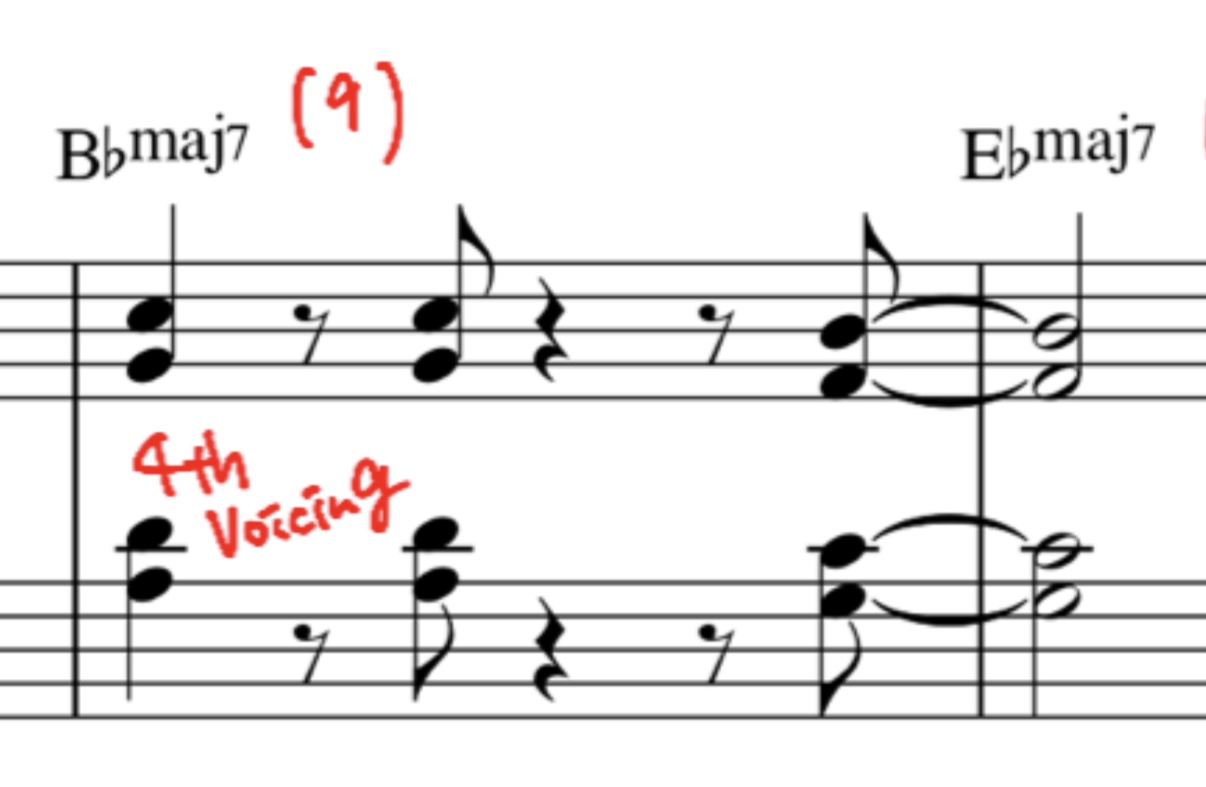
What is it? Quartal voicings are built primarily from fourths rather than the usual stacks of thirds. They can create an open, modern sound and a different way to organize chord tones and tensions.
Practice focus: Compare the intervals between neighboring voices and how each voice moves into the next chord.
Example 5 | So What Voicing
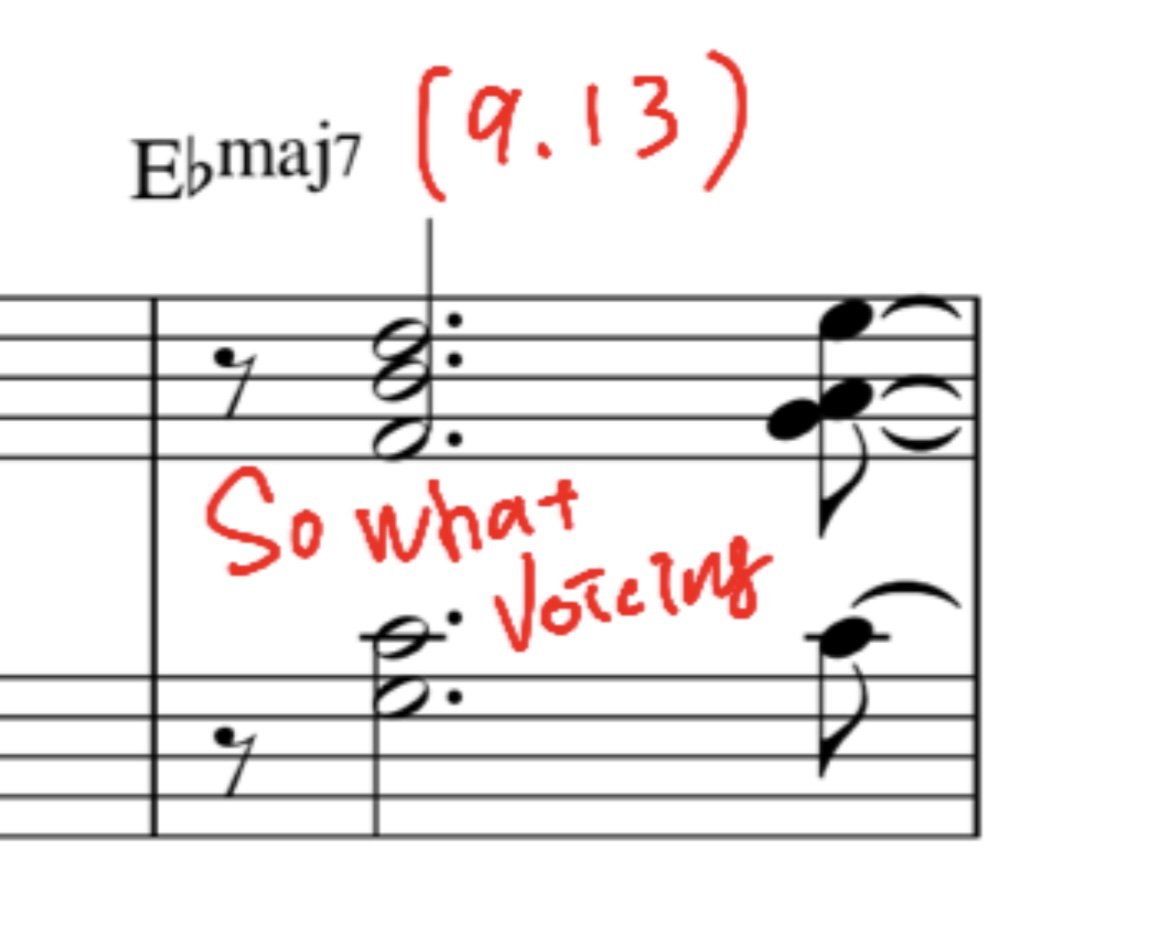
What is it? A classic five-note So What voicing uses stacked fourths with a third at the top. Its open, modal color is distinctive.
Practice focus: Hear how the top third changes the sound of the stacked fourths.
Example 6 | Upper Structure Triad
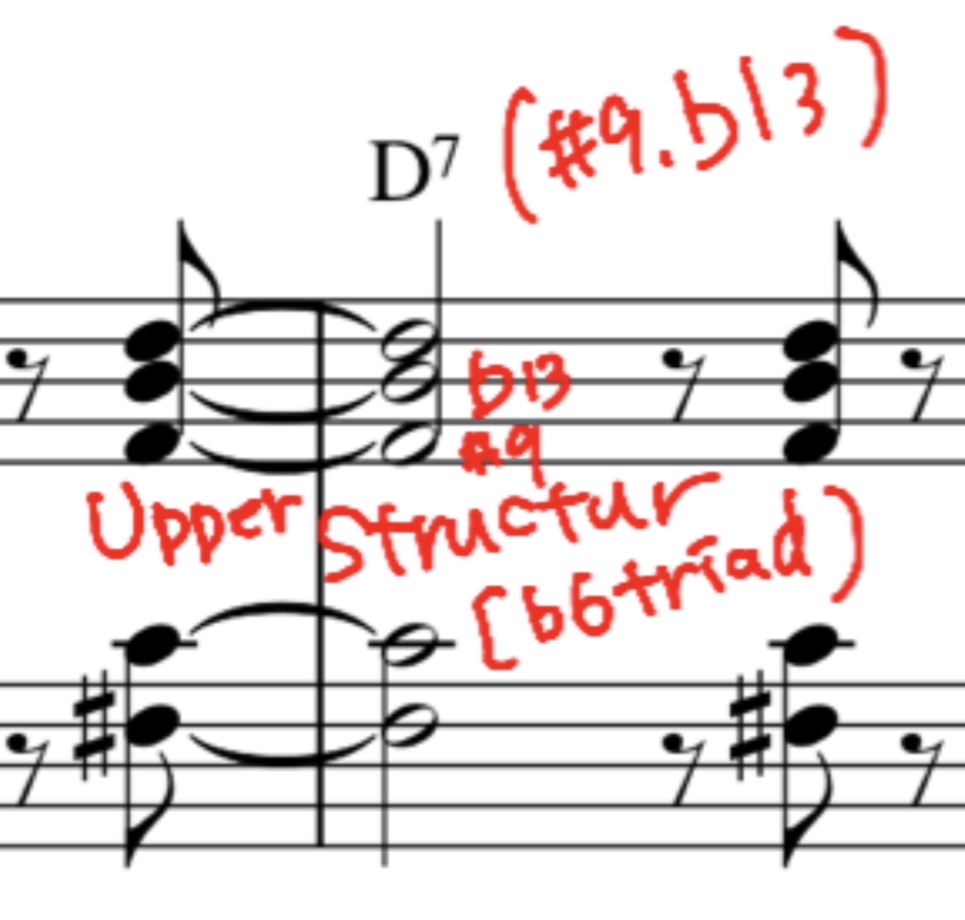
What is it? Place a triad in the upper register over lower notes that establish the underlying chord. On dominant chords, this is a practical way to organize colorful tensions.
Practice focus: Identify the tensions represented by the upper triad and how they relate to the lower voices.
Practice: Change the top note over the same chord, or move only the inner voices, to explore multiple colors within one harmony.
STEP 4 | A 20-minute daily practice routine
- 5 min: Connect chords using only 3rds and 7ths
- 5 min: Add tensions to left-hand voicings
- 5 min: Vary register and top notes with both hands
- 5 min: Compare the videos and record your own playing
STEP 5 | Practice with the backing track
Play the voicings you have learned with the bass-and-drums backing track. Start by placing chords on the beat, then try offbeats and syncopation as you gain confidence.
Produced by Seiya Matsushita · Free streaming
MP3 downloads are provided separately to enrolled students only.
Need help putting these voicings into practice?
After trying the Autumn Leaves exercises, you may have questions about guide tones, voice leading, or choosing tensions. In a one-on-one lesson, we can work on the specific challenges in your playing.
Free 30-minute online trial lesson available