Jazz Piano ii–V–I Progressions: Chords, Voicings & Practice
A 2-5-1 is a three-chord progression built on the second, fifth, and first notes of a key. In F major, it goes Gm7 → C7 → Fmaj7. Start with the bass notes and the thirds and sevenths, then play the four-note left-hand voicings.
How does a 2-5-1 progression work?
The 2 sets up the progression, the 5 creates tension, and the 1 brings it home. In Roman numerals, the major example is ii–V–I and the minor example is iiø–V–i. Lowercase i indicates a minor tonic chord, and ø means half-diminished (m7♭5). In both examples, the V chord has a dominant seventh sound.
At the piano, play G → C → F in the low register, then try D → G → C. The last note of each sequence is the tonal center.
Play a ii–V–I in F major
| Degree | Chord | Chord tones |
|---|---|---|
| ii | Gm7 | G · B♭ · D · F |
| V | C7 | C · E · G · B♭ |
| I | Fmaj7 | F · A · C · E |
Connect the thirds and sevenths
With middle C as C4, play B♭3 · F4 → B♭3 · E4 → A3 · E4 in your left hand. From Gm7 to C7, keep B♭ and lower F to E. From C7 to Fmaj7, keep E and lower B♭ to A. Keeping common tones and moving the other notes by small steps is the basis of smooth voice leading.
Four-note rootless voicings for the left hand
When the bass plays the root, you can leave it out of the left-hand voicing, keep the third and seventh, and add extensions such as the 9th or 13th. For example, the Gm7 voicing below leaves out G and adds A, the 9th. The note names and octave numbers tell you exactly which keys to play.
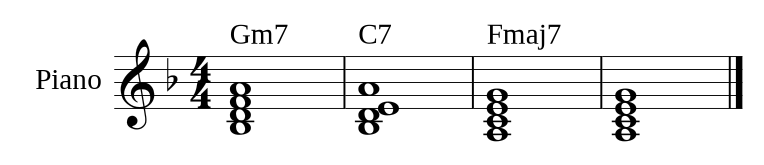
- Gm7 — B♭3 · D4 · F4 · A4
- C7 — B♭3 · D4 · E4 · A4
- Fmaj7 — A3 · C4 · E4 · G4
Play a iiø–V–i in C minor
| Degree | Chord | Chord tones |
|---|---|---|
| iiø | Dm7♭5 | D · F · A♭ · C |
| V | G7 | G · B · D · F |
| i | Cm | C · E♭ · G |
In the basic G7-to-Cm resolution, listen for the third of G7 moving B → C and its minor seventh moving F → E♭. The B in G7 is a half step below C and leads into it.
Listen to the tensions and compare two endings
In this left-hand exercise, imagine the bass playing D → G → C. Add E (the 9th) to Dm7♭5 and A♭ (the ♭9) and E♭ (the ♭13) to G7. At the end, compare the A in Cm6 with the B in Cm(maj7). The score adds D, the 9th, to both endings.
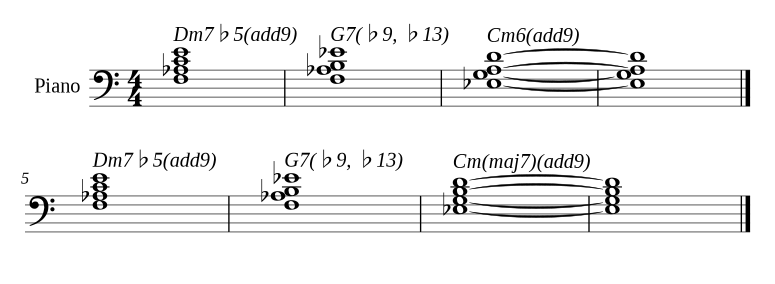
- Dm7♭5 (with 9th) — F3 · A♭3 · C4 · E4
- G7 (♭9 + ♭13) — F3 · A♭3 · B3 · E♭4
- Cm6 (with 9th) — E♭3 · G3 · A3 · D4
- Cm(maj7) (with 9th) — E♭3 · G3 · B3 · D4
From Dm7♭5 to G7, keep F and A♭ and lower C to B and E to E♭, both by a half step. In the basic resolution, B moves from G7 to C in Cm. In this rootless example, the bass supplies C, so the left hand can keep B as the major seventh of Cm(maj7). For Cm6, move B to A. In both endings, E♭ is the minor third that helps you hear the difference from C major.
To match the four notes in the score, choose C minor and Form A. For iiø, select “Add the 9th.” For V, select ♭9 + ♭13. Choose m6 for the top system or m(maj7) for the bottom system.
How to practice as a beginner
- Sing the roots. Play G → C → F or D → G → C slowly and listen to how the last note feels like home.
- Isolate the moving notes. In F major, listen to the half-step moves F → E and B♭ → A before adding the common tones.
- Loop four bars at around 60 BPM. Give ii and V one bar each and I or i two bars. Start with the left hand alone and play the chord on the first beat of the bar.
Four steps to practice with the app
After working through the score, start in F major with Form A. You can try Steps 1–3 without a MIDI keyboard. The screenshots show the Japanese interface.
-
Step 1 · Read and learn the chords
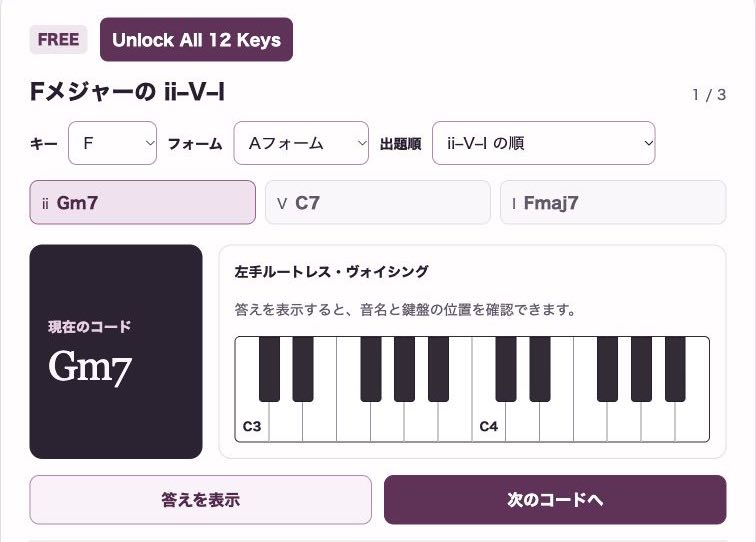
Go through Gm7 → C7 → Fmaj7 in order. Select “Show answer” to learn the four left-hand notes and find them on the keyboard, one chord at a time.
-
Step 2 · Listen and play
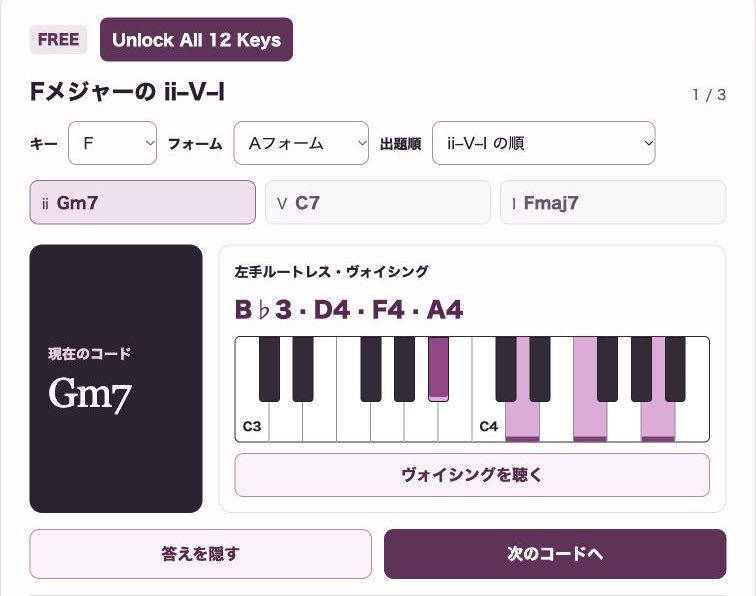
With the answer visible, select “Listen to voicing.” Listen to the chord, then play the four highlighted keys on your own piano or keyboard.
-
Step 3 · Play along with the backing
Choose “In-tempo practice,” set a slow tempo, and select “Play backing.” Use the bass and drums to keep time as you change chords on the first beat of each bar.
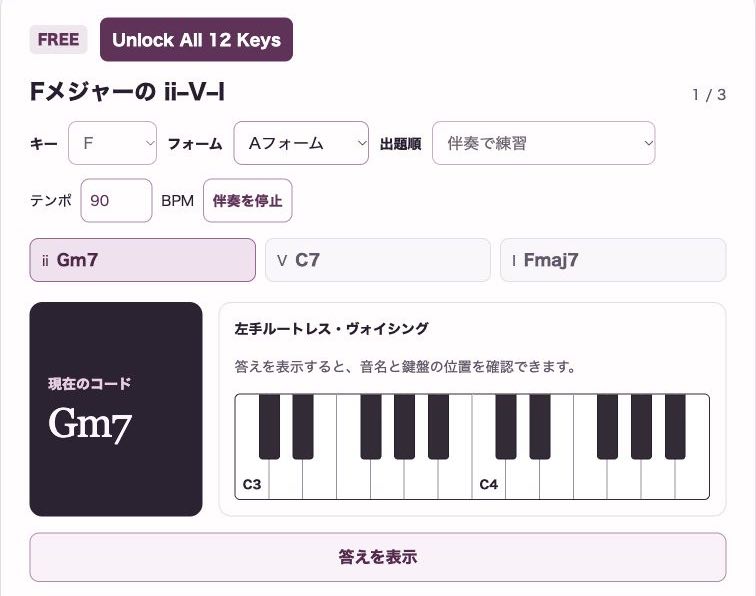
-
Step 4 · Check your notes with MIDI
Use a browser that supports MIDI, connect a MIDI keyboard, and select “Connect MIDI.” Play the four notes to check whether they match the answer.

Try the progression in C minor
Once you’re comfortable in F major, try the iiø–V–i in C minor. In the free version, you can switch between Forms A and B, change the iiø and V tensions, and compare resolutions to m6 and m(maj7).