JAZZ PIANO · FREE LEARNING
What Are Left-Hand Voicings in Jazz Piano?
When the bass player supplies the low notes, your left hand alone can play a full jazz voicing with tensions such as the 9th and 13th. That leaves your right hand free for the tune’s melody or an improvised solo. Follow Gm7 → C7 → Fmaj7 to see how to build these voicings and move between them.
What is a left-hand voicing?
A voicing is the choice of notes, their octaves, and their order within a chord. The basic notes of Gm7 are G, B♭, D and F. The same chord sounds different when you change the lowest note, leave a note out, or add A as the 9th. A left-hand voicing is simply a layout you play with the left hand.
In a rootless voicing you omit the root, such as G in Gm7. When the bass covers that note, the pianist can keep the 3rd and 7th and use the remaining fingers for color. In this C7 example, four notes give you the 3rd, flat 7th, 9th and 13th. If you are playing solo and supplying the bass yourself, try adding the low root separately.
Why practice these voicings?
- Support a melody or solo with one hand. The left hand can keep the chord quality and its tensions audible while the right hand plays the tune or improvises. Learning the shapes gives you more attention for phrasing and timing.
- Hear the harmony change. The 3rd helps distinguish major from minor. Listen to it alongside the 7th to hear the tension in C7 and the arrival on Fmaj7.
- Move smoothly between chords. Keep common notes in place and move the other voices to nearby notes. This is voice leading, and it keeps both the sound and the motion of your hand connected.
Play a ii–V–I in F major
Gm7 is ii, C7 is V, and Fmaj7 is I. Play Gm7 and C7 for one bar each, then Fmaj7 for two bars. The treble clef makes the register of this particular left-hand example easy to read.
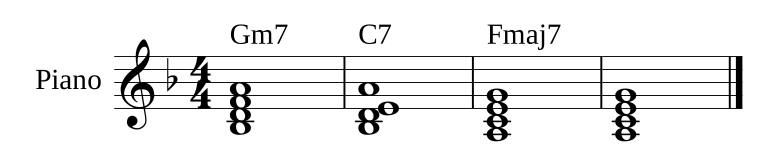
| Chord | Low to high | Degrees from the root |
|---|---|---|
| Gm7 | B♭3 · D4 · F4 · A4 | ♭3 · 5 · ♭7 · 9 |
| C7 | B♭3 · D4 · E4 · A4 | ♭7 · 9 · 3 · 13 |
| Fmaj7 | A3 · C4 · E4 · G4 | 3 · 5 · 7 · 9 |
Middle C is C4. From Gm7 to C7, lower F4 by a semitone to E4. B♭3, D4 and A4 stay put. From C7 to Fmaj7, keep E4 and lower the bottom note from B♭3 to A3. E4 changes from the 3rd of C7 to the 7th of Fmaj7.
Listen with and without the root
Play B♭3, D4, F4 and A4 on their own, then add a low G. The four upper notes can sound like B♭maj7 in isolation. With G beneath them, they give you Gm9. Try adding C below the C7 voicing and F below Fmaj7, or listen to how the backing track supplies those bass notes.
Try a second sound on the tonic: replace E4 in Fmaj7 with D4. The notes A3, C4, D4 and G4 over a low F produce F6/9. Compare the two endings against the melody.
Form A and Form B
In this trainer, Form A starts on the minor 3rd of ii and Form B starts on its minor 7th. The lowest note of Gm7 is B♭ in Form A and F in Form B. Having two positions lets you place the left hand where it sits well against the melody.
Across ii–V–I, the lowest note follows 3rd → 7th → 3rd in Form A and 7th → 3rd → 7th in Form B. The quality of each interval depends on the chord. In this Form A example the low notes are B♭3 → B♭3 → A3.
How to practice
- Isolate the moving voices. Alternate Gm7 and C7 and listen for F4 → E4. Then alternate C7 and Fmaj7 and listen for B♭3 → A3 and the common E4.
- Keep the four-bar loop going. Start around 60 BPM. Play each shape on beat one and count the second bar of Fmaj7 before returning to Gm7.
- Add the right hand. Begin with single notes, then try a short melody. With backing, listen to the balance between the left hand and the melody.
- Transpose. Find the 3rd and 7th of each chord first, then add the remaining notes. Try F → B♭ → E♭ → A♭, moving up a perfect fourth each time.