Minor ii–V–i for Jazz Piano: Tensions and Left-Hand Voicings
Hear how ♭9, ♯9 and ♭13 change a C-minor ii–V–i. Compare left-hand forms A and B, Cm6 and Cm(maj7), and practice with an interactive keyboard.
Practice with the keyboard and backing track · C minor
Reveal the answer to highlight the notes for your left hand. Choose In-tempo practice to set the tempo and play with bass and drums. In a supported browser, connect a MIDI keyboard to check your notes. Switch between forms A and B, tensions and tonic endings.
Build a iiø–V–i in C minor
Play the bass notes D → G → C first. The basic chord tones are Dm7♭5: D, F, A♭, C, G7: G, B, D, F, and Cm: C, E♭, G. B in G7 is the leading tone. Raising B♭ to B on the dominant strengthens the pull back to C.
The player and table show four notes to play with your left hand. They are voicing choices. The bassist can carry the root, though the Dm7♭5 shape without an added ninth includes D in the left hand.
Change one tension at a time
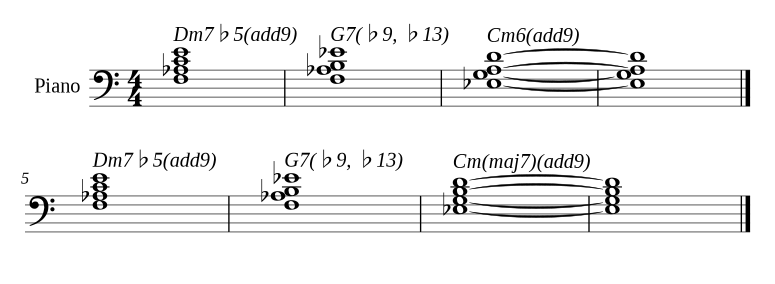
- The ninth on iiø. Select Dm7♭5 and Form A. Adding the natural ninth replaces D4 with E4, while F3, A♭3 and C4 stay put.
- ♭9, ♯9 and ♭13 on V. Select G7 in Form A. Going from ♭9 + ♭13 to ♯9 + ♭13 replaces A♭3 with A♯3, the same key as B♭3. E♭4 stays as the ♭13. For ♭9 + ♭5, keep A♭3 and replace E♭4 with D♭4.
- m6 and m(maj7) on i. Compare the two tonic endings in Form A. Cm6 uses A3 and Cm(maj7) uses B3. Both left-hand shapes also include D4, the ninth.
| Setting | Form A | Form B |
|---|---|---|
| iiø · Add the 9th | F3 · A♭3 · C4 · E4 | C4 · E4 · F4 · A♭4 |
| iiø · No added 9th | F3 · A♭3 · C4 · D4 | C4 · D4 · F4 · A♭4 |
| V · ♭9 + ♭13 | F3 · A♭3 · B3 · E♭4 | B3 · E♭4 · F4 · A♭4 |
| V · ♯9 + ♭13 | F3 · A♯3 · B3 · E♭4 | B3 · E♭4 · F4 · A♯4 |
| V · ♭9 + ♭5 | F3 · A♭3 · B3 · D♭4 | B3 · D♭4 · F4 · A♭4 |
| i · m(maj7) | E♭3 · G3 · B3 · D4 | B3 · D4 · E♭4 · G4 |
| i · m6 | E♭3 · G3 · A3 · D4 | A3 · D4 · E♭4 · G4 |
Change register with forms A and B
On Dm7♭5 with the ninth, form A starts on F3 and form B starts on C4. Both use the same four pitch classes in a different order and register. Try one form throughout the progression, then choose the register that leaves room for the melody and bass.
Find common tones and semitone moves
Use form A with the ninth, ♭9 + ♭13, and m(maj7). Hold F3 and A♭3 from Dm7♭5 to G7, and move C4 down to B3 and E4 down to E♭4. On Cm(maj7), A♭3 moves to G3 and E♭4 to D4, while B3 can remain as the major seventh. In the basic resolution B leads to C. Here the bass supplies the C.
Practice with backing and move through keys
- At about 60 BPM, play one bar of iiø, one of V and two of i. Start by playing the bass notes alone.
- With the free Trainer’s bass and drums, play each left-hand shape on the first beat of its bar. Then change a single V setting and listen to how it resolves.
- Get comfortable in C minor first. When transposing, use the thirds and sevenths as landmarks. The Minor PRO edition covers all 12 keys. In Any Key with backing, match all three chords with MIDI to move up a semitone at the end of the loop.
Official demo
English narration and captions Watch on YouTube